
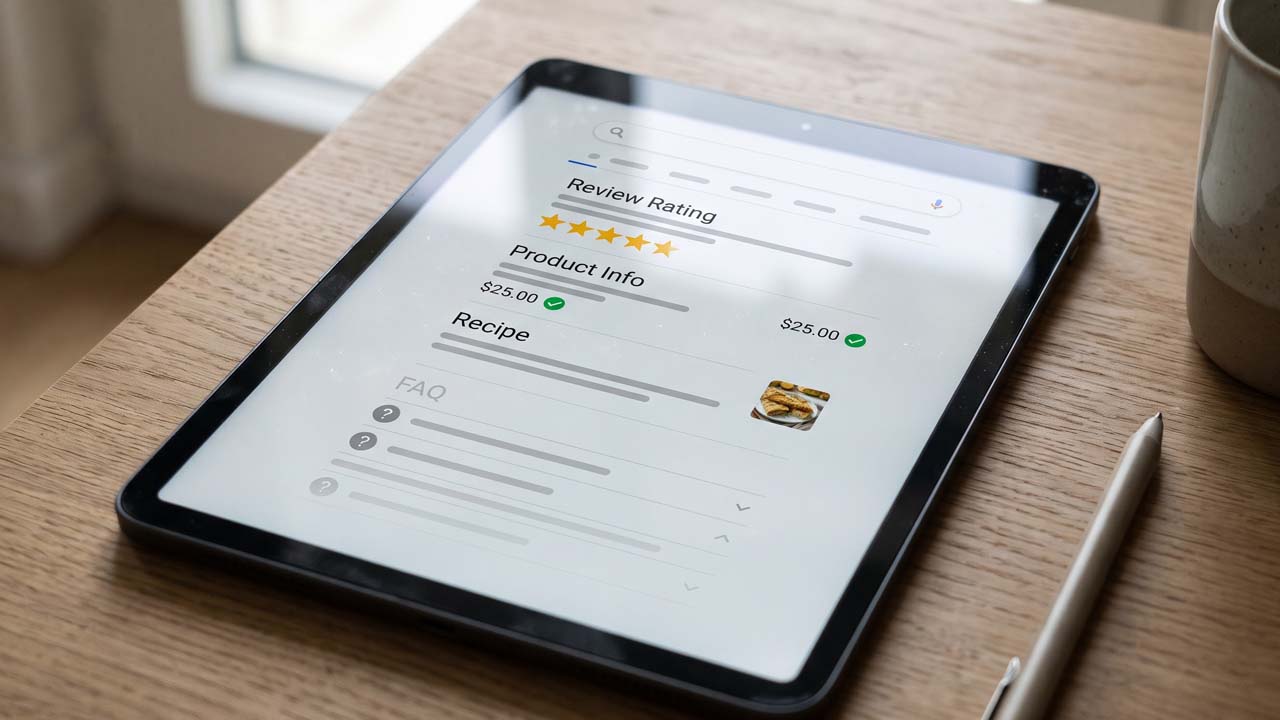
Most FAQ schema advice on the internet is now wrong, and not in a subtle way. It tells you to add FAQPage markup so your questions appear as an expandable list under your search result. That list stopped appearing on May 7, 2026.
The change is worth reading carefully, because the reaction to it has been worse than the change. Some posts describe it as a penalty. It is not. Some say the schema is now harmful. It is not. Google removed a display feature, and the markup that fed it became inert for Google Search. Everything else about the page — the content, the rankings, the traffic — is unaffected by the markup itself.
The Date, the Notice, and the Redirect
This is a recent enough change that the primary sources are still the best ones, and they are short.
Google’s Search documentation updates page carries a May 8, 2026 entry headed “Deprecating the FAQ rich result feature”. The explanation is one sentence:
This feature will no longer appear in Google Search starting May 7, 2026.
A later entry records the follow-up: the documentation itself was removed, because “the FAQ rich result feature is no longer shown in Google Search results, as announced in the changelog entry in May 2026.”
The old documentation URL now proves the point without any commentary. Request it and you get a 301 to the changelog anchor:
curl -sI https://developers.google.com/search/docs/appearance/structured-data/faqpage \
  | grep -i '^location'
The response is /search/updates#removing-faq-rich-result. There is no FAQ rich result guide left to read, because there is no FAQ rich result.
What FAQPage Markup Does Now
FAQPage is still a valid type in schema.org, and the type definition has not been deleted. That is the detail people trip over. Valid markup and a Google feature are two different things.
The markup still does what structured data always did: it describes the page in a machine-readable format. It does not, by itself, change rankings, and it no longer produces a FAQ display in Google Search. Google’s general structured data guidelines state the relationship plainly:
Using structured data enables a feature to be present, it does not guarantee that it will be present.
That sentence was written about eligibility in general, and it applies exactly here. The feature is gone, so there is nothing left for the markup to enable, no matter how clean the JSON-LD is.
What about clicks? A page that used to show an expandable FAQ now shows a standard result. If that display was earning clicks, some of them move elsewhere, and no published figure describes how many. The pages most exposed are the ones where the FAQ was the reason the result stood out, not the ones where the FAQ supported a page that already answered the query.
Two practical consequences follow:
- A validator can still pass it. The Rich Results Test checks syntax and guideline compliance, not whether a feature exists this month. A green result means the markup is well-formed. It does not mean Google will display anything.
- Keeping it is not a violation. The changelog entry announces a removal. It does not describe any action for sites that already publish the markup, and there is no published policy against valid, visible, accurately marked-up FAQ content.
That second point matters because the loudest advice after a deprecation is usually “remove it before it hurts you”. There is no mechanism described for it to hurt you. The honest answer is that the markup is now neutral for Google Search.
Do Not Relabel It as QAPage
If there is one genuinely bad move available here, it is swapping FAQPage for QAPage and hoping Google treats the page as a Q&A result instead.
QAPage is a real, supported feature, and its rules are narrow. The documentation says the markup is for a page where “users must be able to submit answers to the question”, and lists the invalid cases explicitly. One of them is:
An FAQ page written by the site itself with no way for users to submit alternative answers
That is precisely what most FAQ sections are. A company writes five questions and five answers, publishes them, and closes the comments. Marking that page as QAPage is not a clever workaround; it is misrepresenting the page, which the structured data guidelines treat as a content problem rather than a technical one.
QAPage still has a legitimate use: a support forum thread, a product page where customers can post answers, a community question with multiple replies. If your page does not accept answers from users, it is not a Q&A page in Google’s sense.
Keep, Remove, or Rebuild
The decision is about maintenance and honesty, not about recovering a lost feature. Three options, and all three are defensible.
| Option | Choose it when | What it costs |
|---|---|---|
| Keep | The markup matches visible content and a plugin generates it automatically | Nothing, as long as the plugin stays maintained |
| Remove | The markup was added only for rich results, or it describes content users cannot see | A template or plugin setting change |
| Rebuild | The FAQ block itself is thin, outdated, or duplicated across pages | Editorial time, not developer time |
Keep is the right default for most sites. If a plugin outputs FAQPage JSON-LD that matches the questions on the page, there is no urgency. Ripping it out is a change with no Search upside, and changes without upside still carry risk: a template edit can break layout, and a plugin update can reintroduce the markup anyway.
Remove makes sense in two cases. The first is markup that describes content a visitor cannot see — hidden answers, questions that exist only in the JSON, or a template that outputs every FAQ from the database on every page. Google’s guidelines are explicit that you should not “mark up content that is not visible to readers of the page”, and that rule did not expire with the feature. The second is a page builder or plugin that adds the markup to every URL whether or not the page has an FAQ, which is clutter with no remaining purpose.
Rebuild is the option that actually improves something. If the FAQ was written to feed a rich result, it was probably written as five short questions with one-line answers, chosen for the display rather than for the reader. That is the moment to check whether the questions match what people ask in support tickets and search queries, and whether the answers deserve more than a sentence.
What no option requires is a site-wide emergency. The feature’s removal is not a signal that your content is now deficient.
What Still Earns a Rich Result
The structured data gallery is the current list, and it is the page to check instead of a blog post with a year in the title. The features below are still documented, and each has its own eligibility rules.
| Feature | What it describes | Typical WordPress use |
|---|---|---|
| Article | A news, sports, or blog article with author and date | Blog posts |
| Breadcrumb | The page’s position in the site hierarchy | Any page with a trail |
| Product | Price, availability, and review data | WooCommerce products |
| Review snippet | A review or rating about a specific item | Product and service pages |
| Video | A video with a watch page and metadata | Embedded or hosted video |
| Event | A dated event with location and offers | Webinars, classes, shows |
| Recipe | Ingredients, steps, times, and images | Food blogs |
| Organization | Logo, legal name, contact details | Sitewide, on the homepage |
| Local business | Address, hours, and location data | Local service pages |
| Job posting | A live job with salary and location | Careers pages |
Two rules apply across the table. The marked-up content has to be visible on the page, and eligibility is not a promise. The gallery says it directly: “The actual appearance in search results might be different.”
If you are choosing one feature to invest in this quarter, choose the one that matches pages you already have and already maintain. Adding Product markup to ten products is a bounded project. Adding Event markup to a calendar nobody updates produces expired events, and Google’s guidelines warn that time-sensitive content which is no longer relevant will not be shown.
The Q&A Content Is Still the Asset
The markup lost its display. The questions did not lose their value. A well-written FAQ still answers the objection that stops a purchase, reduces support email, and gives a page a section that matches how people phrase a search.
What changes is the reason to write one. Without a rich result to chase, the test is whether a reader would stay for the answer.
- Use the question as the heading. “How long does shipping take?” is a better H2 or H3 than “Shipping Information”, because it matches the query and tells the reader what the section answers.
- Answer in the first sentence. A FAQ that opens with three paragraphs of context is a blog post wearing a question mark.
- Keep answers short enough to scan, long enough to be true. One or two sentences for a factual question; a short paragraph plus a link when the answer depends on the reader’s setup.
- Link the deeper page. The FAQ introduces the topic; the guide covers it. The internal linking guide covers why that link belongs in the body rather than in a related-posts widget.
- Check the accordion. A collapsed answer still needs to exist in the HTML, and the toggle needs a real button with an accessible name. The accessibility guide covers the markup side, which matters for readers using a keyboard or a screen reader.
The SEO basics guide makes the broader point that applies here: content and crawlability carry the page, and structured data is a description layer on top. When the description layer stops being displayed, the layer underneath is what remains.
Audit the Plugin Claims
FAQ plugins have a marketing problem now. Many of them still list “FAQ schema” and “rich results” as features, because the plugin still outputs the markup and the marketing copy has not caught up.
That does not make the plugins useless. A good FAQ plugin still gives you a repeatable block, consistent styling, and an accordion that works on mobile. It just no longer gives you a Google display.
Three checks before you buy, migrate, or renew:
- Look at the changelog, not the feature list. If the last release notes mention schema changes, the developer is paying attention. If the plugin has not shipped in two years, the schema output is the least of your maintenance concerns.
- Inspect the output. View the source of a page with the FAQ and search for
FAQPage. If it is there, the plugin is still emitting markup that Google ignores. If the plugin lets you turn the schema off, that is a sign of a maintained product. - Test the reader experience first. Keyboard navigation, focus states, and whether the answer is in the initial HTML matter more than the JSON-LD block now.
The reviews guide is a useful contrast: review snippets are a feature that still exists, with their own rules about who can mark up a review and what it has to represent. The difference between a feature that survived and one that did not is not the quality of the markup. It is whether Google still chooses to display it.
Verify It Yourself
Two commands answer the two questions that matter: what does my site output, and what does Google currently document?
# 1. Does this page still emit FAQ structured data?
curl -s https://yourdomain.com/faq/ | grep -c 'FAQPage'

# 2. Where does the old FAQ documentation point now?
curl -sI https://developers.google.com/search/docs/appearance/structured-data/faqpage \
  | grep -i '^location'
The first number is a count of occurrences, not a verdict. Zero means no markup on that page. A positive number means the markup is present, which is fine, as long as it matches what a reader sees.
The second command returns the redirect to the changelog anchor. That is the part worth bookmarking: the documentation moved, and the anchor is where the removal is recorded.
For a broader check, open the gallery and search the page for the feature you are considering. If it is not in the list, it is not a current Google feature, no matter what a plugin page says.
What This Says About Structured Data Strategy
The FAQ deprecation is a clean lesson in what structured data is for. It is a contract between your page and one specific consumer, and that consumer can change the terms.
That is not a reason to avoid structured data. It is a reason to stop treating any single rich result as the plan. The sites that lost the most from this change were the ones whose FAQ pages existed only to produce the display: thin questions, one-line answers, no links, no reason for a reader to stay. The sites that lost nothing were the ones with useful FAQs that happened to be marked up.
The same logic applies to every feature in the gallery. Product markup is worth doing because product pages are worth doing. Article markup is worth doing because articles are the business. Event markup is worth doing when the events are real. The markup is the last ten percent, and it is the ten percent that can be removed by a changelog entry.
The semantic SEO guide covers the layer underneath: entities, relationships, and content that answers a topic rather than a template. That work does not disappear when a display feature does, and the ranking guide covers the signals that were never in the JSON-LD to begin with.
FAQ
Is FAQ schema still supported?
The schema.org type still exists, and validators will still parse it. Google Search no longer displays FAQ rich results, so the markup has no effect on search appearance. Those are two different kinds of “supported”, and only the first one still applies.
Did FAQ schema ever help rankings?
Structured data is an eligibility mechanism for a display feature, not a ranking signal. Google’s guidelines say structured data enables a feature to be present and does not guarantee that it will be. The FAQ markup could earn a display; it did not lift positions on its own.
Should I remove FAQ schema from my site?
Only if it is inaccurate, describes hidden content, or is being added to pages that have no FAQ. If it matches visible content and a maintained plugin generates it, leaving it in place has no Search cost. Removing it is optional maintenance, not a fix.
Will removing FAQ schema hurt my SEO?
The visible content is what ranks. Removing the JSON-LD does not remove the questions, the answers, or the internal links. The only thing that changed is a display feature Google has already retired.
Can I use QAPage markup instead?
Not for a site-written FAQ. Google’s QAPage guidelines require that users be able to submit answers, and they list “an FAQ page written by the site itself with no way for users to submit alternative answers” as an invalid use case.
Do FAQ plugins still work?
The blocks and accordions still work. The schema they output is inert for Google Search. Judge the plugin on the editing experience, accessibility, and maintenance rather than on a rich-result feature it can no longer deliver.
Which rich results still exist in 2026?
Article, breadcrumb, product, review snippet, video, event, recipe, organization, local business, job posting, and several others are still documented in Google’s gallery. Each has its own requirements, and appearance is never guaranteed.
How do I know when a rich result is deprecated?
Check the Search documentation updates page and the structured data gallery directly. Blog posts and plugin landing pages lag behind both, sometimes by years, and a post with a year in the title is the least reliable source available.
Leave a Reply