
The Shift from Company-Led to Customer-Led Growth
For decades, business growth was driven primarily by company-led activities: advertising campaigns, sales teams, product launches, and market expansions. While these approaches remain important, a fundamental shift is underway. The most efficient growth now comes not from what companies say about themselves but from what their customers say about them.
Customer-led growth recognizes that every satisfied user is a potential distribution channel. When customers voluntarily recommend your product to colleagues, share their success stories on social media, or write unsolicited positive reviews, they generate trust-based awareness that no marketing budget can buy. The question is whether companies are equipped to amplify and scale this organic advocacy.
Why Customer Advocacy Outperforms Traditional Marketing
The mechanics of customer advocacy create several structural advantages over company-driven marketing. Trust is the most obvious: people trust peer recommendations far more than corporate messaging. But there are subtler advantages that compound over time.
Customer advocates pre-qualify their referrals. When a product manager recommends a project management tool to a peer, they implicitly certify that the tool fits the use case, budget range, and technical requirements of someone similar to themselves. This pre-qualification means that referred prospects arrive with higher intent and clearer expectations, leading to faster conversions and lower churn.
The targeting precision of customer advocacy is unmatched by any algorithm. Your customers know their professional networks intimately and naturally route recommendations to the people most likely to benefit. No amount of demographic targeting or behavioral profiling can replicate the contextual intelligence that a human referrer brings to each recommendation.
Building Infrastructure for Customer-Led Growth
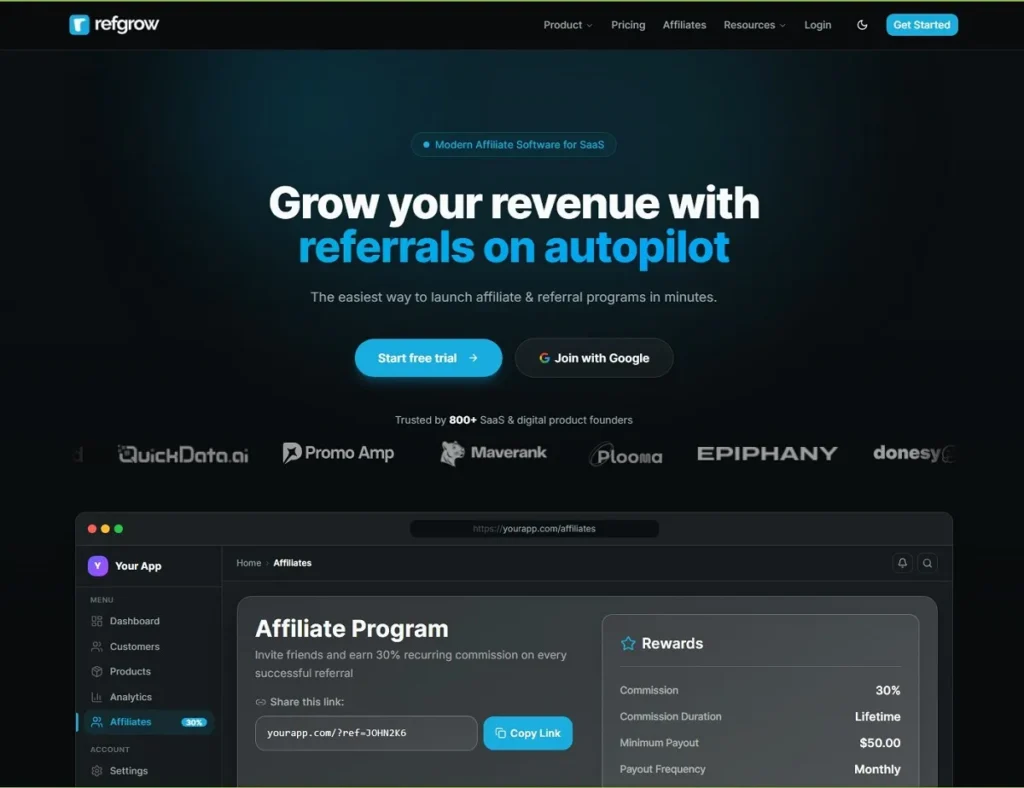
Organic advocacy happens naturally in small quantities, but scaling customer-led growth requires deliberate infrastructure. Referral programs, advocacy platforms, community spaces, and customer success initiatives all contribute to an ecosystem that amplifies and rewards customer voices.
The technology layer is critical. Customers who want to refer your product need simple tools to do so: shareable links, pre-written messages they can personalize, social sharing widgets, and transparent tracking that confirms their referrals are being recognized. Platforms like Refgrow provide this infrastructure out of the box, enabling companies to launch customer referral programs that feel native to their product experience.
Incentive design requires nuance in customer-led growth models. Unlike affiliate programs, where financial motivation is primary, customer advocacy programs must balance tangible rewards with intrinsic motivations. Many of your best advocates are not primarily motivated by money; they refer because they genuinely want to help their peers. The reward structure should acknowledge and enhance this motivation rather than replacing it with a purely transactional dynamic.
Embedding Advocacy into the Customer Journey
The most effective customer-led growth programs embed referral opportunities at moments of peak satisfaction rather than treating them as separate campaigns. Product milestones, successful support interactions, positive NPS responses, and feature discovery moments all represent natural opportunities to invite customers to share their experience.
Timing matters enormously. Asking for a referral during initial onboarding feels premature because the customer has not yet experienced enough value to make a credible recommendation. Asking after a significant success moment capitalizes on genuine enthusiasm and produces referrals backed by real experience. Understanding your product’s value realization timeline is essential for identifying the optimal moments to prompt advocacy.
In-product prompts should feel helpful rather than intrusive. A contextual message like “Your team just hit a milestone — want to invite other teams who might benefit?” is far more effective than a generic “Refer a friend!” banner that interrupts the workflow. The key is making the referral prompt feel like a natural extension of the positive experience the customer is already having.
Measuring Customer-Led Growth
Traditional marketing metrics do not fully capture the value of customer-led growth. In addition to standard referral metrics like participation rate and conversion rate, companies should track advocacy depth: how many referrals each advocate makes over their lifetime, how their referred cohorts perform compared to other acquisition sources, and how advocacy correlates with the advocate’s own retention and expansion.
The most revealing metric is often the simplest: what percentage of new customers cite a peer recommendation as their primary reason for evaluating your product? When this number grows consistently over time, it signals that customer-led growth is becoming a structural competitive advantage rather than an incidental benefit.
Companies that master customer-led growth build moats that competitors cannot easily replicate. While advertising budgets can be matched and sales teams can be hired, a genuine culture of customer advocacy takes years to develop and creates compounding returns that accelerate with every new satisfied user who becomes an active promoter.
Leave a Reply