

Yet many operators run courier operations without centralized systems or courier management software, and at first, it seems fine. A couple of drivers, a few regular clients, a spreadsheet or two to keep everything straight, it works. It works until it’s no longer working, and that ten, hundred deliveries per day and more becomes the system’s downfall. Yet what many courier operators don’t realize is that this downfall isn’t just irritating inefficiencies; it’s the hidden cost of avoiding a professional courier management software solution.
Table of Contents
Why? Because the costs are hidden in plain sight. There’s no line item for “time wasted looking for memos” or “customer canceled due to lack of availability.” They’re costs that re-inflate over time, ignored like other parts of the operational game. But they shouldn’t be. They should be addressed, and they’re almost an inherent symptom of running such a modernized operation on tools that work better in more rudimentary times.
The Cost of Information Silos Without Courier Management Software
Here’s where it gets costly, even if at first it doesn’t feel so. Courier operations without centralized systems usually end up with information in a million places. Bookings are in emails. Driver schedules are in group chats. Delivery confirmations are in texts/photos sent to devices. Addresses are on one spreadsheet, invoicing in another application entirely.
This is an operational tax on every single action. Every time someone needs to check the status of a delivery, they need to source several items, none of which will be found in one location. When a customer calls about their delivery, the person answering needs to Frankenstein the answer before they can responsibly respond. Businesses that utilize comprehensive courier software USA providers never need to endure this scavenger hunt; businesses operating without it experience this time sap on literally every single delivery.
This equates to hidden labor costs. If it takes someone three minutes instead of 30 seconds to find information for one delivery, and the courier company has 200 deliveries per day, there are 10 extra staff hours just spent figuring out basic information every day. Over a month, that’s around a whole staff person’s worth of hours dedicated to something that should be automatic. At median costs per hour, that’s thousands of dollars per month in lost labor that will never be attributed to the absence of a robust courier management software.
The Coordination Challenge That Never Ends
Deliveries require constant coordination across various parties, from customers to dispatchers to drivers, and often multiple pickup or delivery points. Without a dedicated courier management software, this occurs through exhausting phone calls and texts, each an area for failure.
Phone calls interrupt what another person is doing and rarely come at a good time for either party. Important details are forgotten or misremembered. Text chains balloon into dozens of messages that are impossible to read with multiple jobs occurring simultaneously, and verbal callbacks disappear as fast as they’re delivered, with no record keeping for later discussion about what was actually relayed.
There’s a cost of time involved, but there’s also an invisible cost of mistakes. A driver doesn’t show up because the last-minute coordination didn’t come through by word of mouth fast enough. Customers are told their product will be delivered by noon when they’ve requested that, which means to avoid peak hour traffic between 12 p.m. and 2 p.m., but there’s no system for accountability, so everyone suffers small issues.
Every mistake comes with a follow-up. Someone needs to let the customer know what’s going on. The dispatcher needs to adjust the plan. The driver might have to turn around or take an extra trip. All of this costs time that could have been spent on billable hours. Even worse, it damages customer relationships where risk cannot be quantified, but always exists. Multiple mistakes during coordination make customers look elsewhere for better solutions provided by competitors using courier management software.
Maximizing Driver Efficiency with Courier Management Software
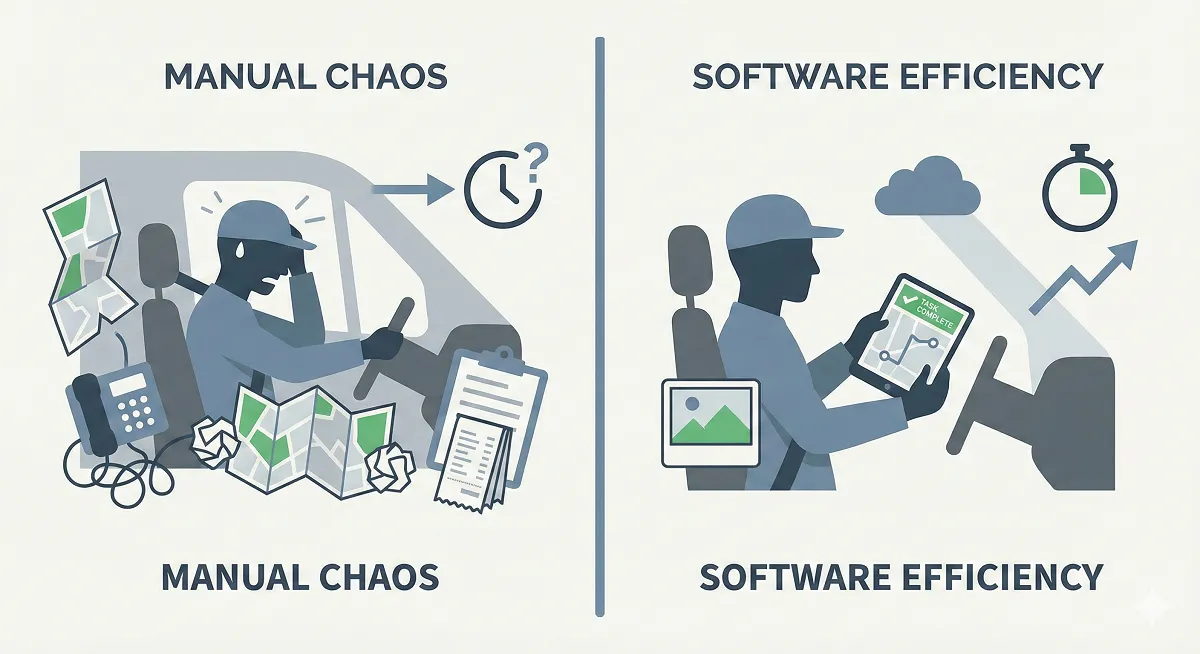
Drivers working for courier companies without good management systems operate for far more hours doing non-deliverable work than useful work. Without the automation provided by courier management software, they’re calling into dispatch without details for their next job. They’re trying to sort out how to best get to their multiple stops along complicated routes to maximize efficiency, but fall short because they’re trying to do this within poor systems. They’re trying to document their efforts through paper receipts when proof-of-delivery documentation may require a photo for oversight to develop into next action steps.
Every minute wasted in administrative-type tasks is one minute not focused on deliveries for a courier operation, and this means capacity is ever impacted as well. A driver who should complete 20 deliveries on one shift might complete 15 instead because 5 minutes per drive go toward coordination/documentation efforts instead of actual moving and sorting efforts. Twenty percent less delivery counts equals 25% less productivity, meaning companies have no choice but either lower revenue efforts or bring on more drivers just to catch up.
The vehicle costs never go away during this time, either, because as long as they are idle during phone calls…that’s fuel, insurance, and maintenance options going toward completed on-paper jobs but not effectively done through delivery systems; acquired costs per vehicle hour are compensated this way unless proven otherwise by the data in your courier management software.
It becomes even more disheartening when small efficiencies are observed by drivers when they feel they’re wasting time operating when they shouldn’t have to. Good drivers know when they’re just bogged down by the system as opposed to enjoying their shifts, actually delivering quality support. When good drivers become frustrated, they leave, and losing those valuable drivers means recruiting new talent, which costs money.
The Visibility Gap That Costs You Sales
Customers today expect visibility into their deliveries at all times, and it’s not an unreasonable luxury; it’s a basic expectation developed by years and years of consumer delivery tracking, with relevant commodities able to provide such support at any time. When your customer can confirm where their package is at any moment in time, and you cannot provide that support with a courier service, it doesn’t just frustrate customers; it actively costs you sales.
Potential customers are likely weighing their options, and part of that consideration lies in professionalism and responsiveness. If a business can quickly provide them a tracking ID or access information with full transparency via courier management software, they’re perceived as far more capable than a business where they call in only for someone to have to look up their driver.
The hidden cost here is every potential customer who goes with a competitor because the tracking/communication looks better.
Current customers feel the same, and when they cannot access said information easily enough, they call. A cumulative amount of time it takes staff who respond, look up information across multiple sites, and then hope they have adequate answers, they can’t guarantee it unless they find something significant. For a business that plans hundreds of deliveries weekly, this adds up; customer service-oriented labor overhead absolutely exists when the only reason why there’s no connection is that information is dispersed elsewhere.
Companies that utilize a comprehensive courier management software don’t eliminate customer service inquiries; they drastically limit “where’s my delivery” categories that could’ve been handled simply by providing visibility up-front.
When Data Doesn’t Actually Help Anyone
Companies with decentralized operations still access data, a solid percentage of deliveries are made by jobs kept in separate files, folder work up until delivered vehicles come back for additional advanced efforts, but that’s where it ends; even worse, it’s hard-access data that’s compartmentalized throughout applications and documents that makes research virtually impossible.
Want to know what the most successful daily route is? Combine delivery records with logged driver times, vehicle efforts, and dollar values acquired via invoicing features; good luck accessing them all from different places without any rhyme or reason. Want to know which customer segments boast the best jobs? Good luck matching customer requests with payment and job details by piecing everything together once again.
The problem with all this data exists because it means decisions today are made based on the gut feeling instead of actual research; they might extend services that cost them too much money without realizing they’ve done the math yet; they might decide against extending high-demand hours when it’s clear through multiple locations that margins show potential success since no one’s done the math with easy access information.
For new courier operations without centralized systems, this isn’t an issue. When advanced considerations are at stake down the line, it’s poor decision-making from non-accessible data that helps develop patterns that could’ve been avoided otherwise. Once again, they fail to connect why the lack of courier management software causes problems down the line, but logical connections steer the inevitable reality instead.
The Growth Problem That Emerges Suddenly
Small operations can usually back through basic systems and manual coordination easily enough under basic limits. Still, there’s always a threshold where this fails from anticipated success, and companies rarely see it coming until they’re stuck knee-deep in disaster syndrome anyway. But as you scale, the lack of courier management software becomes an operational nightmare.
Growth that should materialize as good news becomes an operational nightmare because systems that barely worked out at smaller scales collapse before those with higher volume power completely fall apart and seemingly work against small businesses instead.
The way this happens operates, and it’s a company that’s busier than ever but far less profitable; sure, they’re getting more jobs, but it’s also an inconsistent quality of service they’re receiving due to increased mistakes.
Customer complaints rise, overtime hours devour once-simple service capabilities because no one can figure out an efficient route anymore; owners increasingly work longer hours just trying to manually make this work.
To outsiders looking in, it’s a success, but internally, it’s chaos, and it’s feasting on profit margins from additional jobs since overage isn’t anticipated or reconciled appropriately against previous thoughts.
The sad reality is this causes many small businesses to believe they aren’t cut out for growth when they’ve simply outgrown their tools, the actual problem isn’t that they’re incapable of growth, it’s spreadsheets and group chats that can’t grow, and thus when companies reach this wall they’re prompted either acquire systems themselves, or level off below their market potential for where they’d fair otherwise.
The hidden cost of staying small is substantial, but it often doesn’t get framed in association with the absence of courier management software unless someone connecting the dots brings it up.
Making It All Add Up
Ultimately it’s obvious financially how centralized software makes sense once all hidden costs are laid out on paper, from inefficient labor wasted looking up basic information to coordination efforts needed without consistent approaches creating lost staff hours; the inefficiency related to driver productivity decreased from excessive non-driving to overhead costs billed without useful effort totals; unclear visibility reporting making bad decisions easier over time using data that’s not obtainable; false growth ability creating questions about scalability, every blip falls victim into the extensive realm of profitability.
Most courier companies find that their systems return their courier management software investment within months, simply based on operational efficiencies found. In addition, the reduced costs associated justify justification enough, and what’s discovered later is far easier: better retention efforts from customers, partner work, better driver efficiency projects, experienced portability which repurposes between facilities, creating all additional values, creating universally good sense, and hindsight making decisions clear.
It’s not whether centralized systems can save money; there are numbers to prove that it’s possible. The question really is, how much longerdo companies want to pay hidden costs for running operations without centralized systems?
Every single delivery bears tax every day, delayed in making decisions otherwise.