
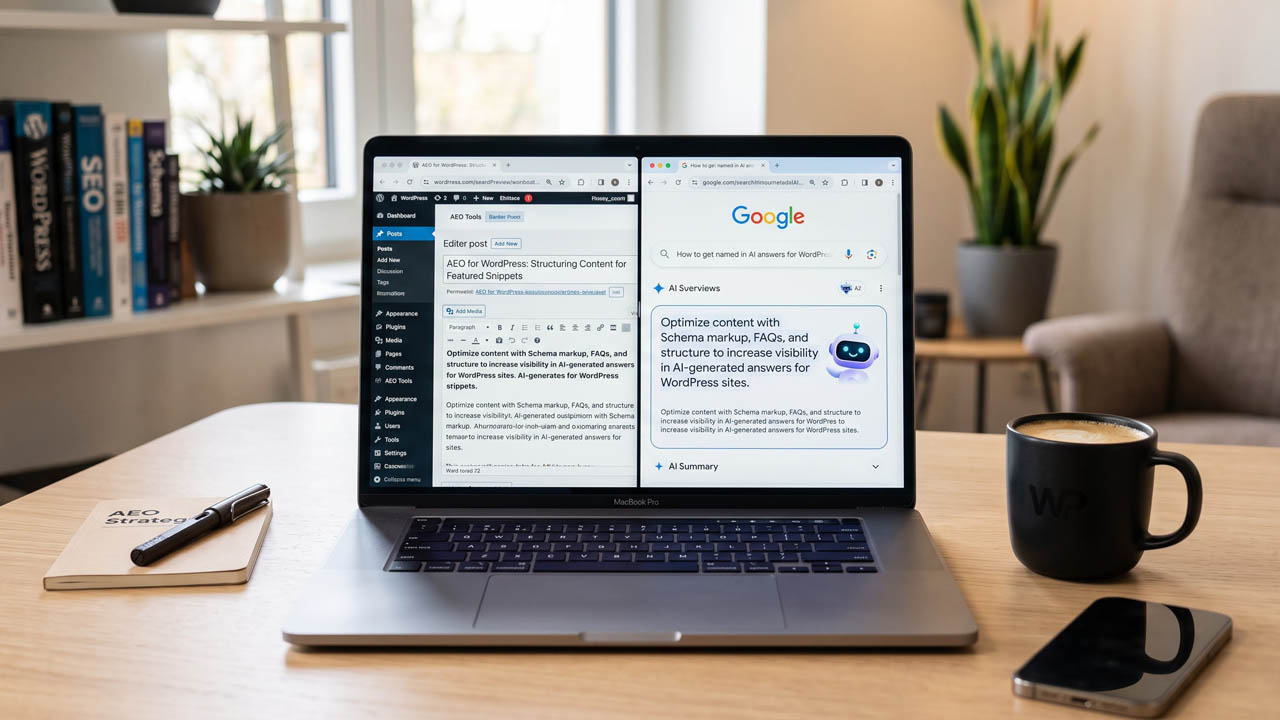
Answer Engine Optimization (AEO) is the practice of structuring your WordPress site and online presence so AI answer engines like ChatGPT, Perplexity, and Google AI Overviews name your business as a trusted source. Where SEO earns you a ranking, AEO earns you a citation inside the answer itself.
That distinction matters more every month. A growing share of searches never produce a list of links at all. The user asks a question and gets one synthesized answer that names a few businesses. If you are not one of those names, you are invisible no matter how well you rank. Closing that gap is the entire job of an AEO-focused agency like Escape Web Development: not to get you listed under the answer, but named inside it.
Why AEO Matters More Than Ever in 2026
Google AI Overviews now appear on a large and growing percentage of search results pages. Perplexity answers millions of queries daily without ever sending users to a website. ChatGPT Search and similar tools pull from web content to generate direct answers. The pattern is clear: the future of search is conversational, and the winner is whoever the AI names, not whoever ranks tenth on page one.
For WordPress site owners, this shift is both a threat and an opportunity. WordPress powers over 40 percent of the web, which means there is an enormous amount of WordPress-based content already indexed by these systems. The question is whether your content is structured well enough for an AI to trust it, cite it, and ultimately name your business when a user asks a relevant question.
How AEO Differs from SEO
SEO optimizes a page to rank for a keyword. AEO optimizes your whole entity — your business as a recognizable, trusted thing — so a model feels confident naming you. SEO asks, “Can I rank this page?” AEO asks, “When someone asks about my industry, does the AI trust me enough to say my name?” You still need SEO fundamentals underneath. AEO layers a new goal on top.
Think of it this way: SEO is about earning visibility on a results page. AEO is about earning a mention inside the answer itself. With traditional SEO, you compete for ten blue links. With AEO, you compete to be one of the three to five sources an AI synthesizes into a single response. That means fewer slots, higher stakes, and a completely different set of signals that determine whether you get included.
How AI Decides Who to Cite
Answer engines assemble responses from sources they consider authoritative and unambiguous. They favor content that answers a question directly, businesses described consistently everywhere, and names that appear across trusted third-party sources. Consensus is the signal — if several reputable places say the same thing about you, the model repeats it. You can learn more about how search engines evaluate content from the Google Search documentation on AI Overviews.
Several specific factors influence whether an AI model cites your content. First, factual accuracy matters. Models cross-reference claims across multiple sources. If your content states something that contradicts established facts, it gets deprioritized. Second, content freshness plays a role. Pages updated recently with current data and statistics signal that the information is maintained and trustworthy. Third, entity recognition is critical — the model needs to clearly understand who you are, what you do, and where you operate. This is why consistent NAP (Name, Address, Phone) data across your site and directories directly affects your AEO performance.
The AEO Checklist That Actually Works for WordPress Sites
1. Answer First
Open every blog post and every service page with the direct answer in the first line or two. Do not bury it under a long intro. Models lift the clearest, earliest answer on the page. If you are using a theme from WP Frank, the content blocks and layout options make it easy to place a bold, answer-first section at the top of any page.
This technique is sometimes called the “featured snippet inverted pyramid.” Instead of starting with background context and building to the answer, you lead with the answer and then provide supporting details. For example, if your post is about “best WordPress caching plugins,” your opening sentence should name the top pick and explain why — not start with “In the ever-evolving world of website performance…” AI models scan the first 150 to 200 words most aggressively when deciding whether to cite a page.
2. Add FAQs to Every Page
Target the real questions people ask and answer each in a couple of plain sentences. FAQ blocks are among the easiest content for an answer engine to quote verbatim. You can build FAQ sections using any SEO-optimized WordPress themes that support Gutenberg patterns or Elementor widgets.
Use tools like AlsoAsked, AnswerThePublic, or Google’s “People Also Ask” boxes to discover the exact questions your audience is typing. Then structure each FAQ answer as a concise, self-contained paragraph that could stand on its own as a response. Avoid vague answers like “It depends” — give specific, actionable information. For WordPress businesses, common high-value FAQ topics include pricing, setup time, compatibility with popular page builders, and support availability.
3. Use Fresh Listicles and Citations
“Best of” and comparison content is AI’s favorite format to cite. Creating fresh listicles gives you more control, speed, and ROI than chasing existing ones. It is worth pointing some link budget at reputable directories like Clutch and DesignRush.
When building listicles for your WordPress business, focus on genuine comparison criteria. Include specific features, pricing tiers, pros and cons, and real use cases. AI models favor list content that provides structured, easy-to-parse information over vague recommendations. If you sell WordPress themes or plugins, creating comparison posts like “Elementor vs. Gutenberg: Which Page Builder Fits Your Workflow?” gives AI a clear, citable source when users ask about page builder options.
4. Vet Where You Appear for LLM Crawler Access
A mention is only useful if the AI can read the page. Before you publish or buy a placement, check that the site does not block crawlers like GPTBot, ClaudeBot, Google-Extended, or CCBot in its robots.txt. A blocked page cannot be pulled into an answer.
This is a commonly overlooked step. Many high-authority sites and directories quietly block AI crawlers in their robots.txt files. A backlink from such a site still has traditional SEO value, but it provides zero AEO value because the AI cannot read the page content to understand the context of the mention. Before investing in guest posts, sponsorships, or directory listings, use a robots.txt checker to verify that the major AI crawlers are not blocked. This simple audit can save you hundreds of dollars in placements that would otherwise be invisible to answer engines.
5. Build Unlinked Brand Coverage
AI weighs plain mentions of your name, not just links. Podcasts, social platforms, and press that simply say your business name all reinforce the entity. For WordPress site owners, this means your brand presence on coverage.AI and similar platforms matters as much as traditional backlinks.
Entity consistency is the foundation of unlinked brand coverage. Your business name, description, and key details should be identical across your website, Google Business Profile, social media bios, directory listings, and any press mentions. When an AI encounters the same information about your business from five different sources, it builds confidence that the entity is real, established, and trustworthy. Even a single inconsistent detail — like a slightly different business name on Yelp versus your website — can weaken that signal.
6. Target Your Real Location
Point your local content at the market where you actually hold your Google Business Profile. Consistent name, service, and location signals are what let a model connect you to “in [your city]” queries.
Local AEO is especially powerful for WordPress businesses serving specific markets. If you are a WordPress agency in Austin, your content should mention Austin naturally and repeatedly — not as keyword stuffing, but in the context of real projects, local client testimonials, and area-specific services. Create location-specific landing pages that describe the neighborhoods or regions you serve. Include your Google Business Profile embed on these pages. When someone asks an AI “Who is the best WordPress developer in Austin?” these consistent signals are what get you named in the response.
7. Use the Cheaper Channels
YouTube, Reddit, LinkedIn, Instagram, Threads, X, Medium, Ghost, and Substack are low-cost places to publish citable, consistent content and get mentioned in the threads AI increasingly pulls from.
These platforms matter for AEO because AI models are trained on and actively index content from them. A well-written Reddit thread about WordPress performance optimization, a YouTube tutorial on your plugin, or a LinkedIn post about a recent project all create additional touchpoints where an AI can find and cite your brand. The key is consistency: use the same business name, the same description, and the same value proposition across every platform. Spreading thin across ten channels with inconsistent messaging is worse than being excellent on three.
8. Stack Reviews
Consistent, positive reviews on Google, Yelp, Clutch, and relevant local directories are strong trust signals that reinforce you as a real, recommended option.
Reviews serve a dual purpose in AEO. First, they are direct trust signals — an AI seeing fifty positive Google reviews with detailed descriptions of your WordPress services is far more likely to recommend you than one with two generic reviews. Second, reviews often contain the exact language real customers use to describe your value, which gives the AI natural phrasing to echo in its responses. Actively encourage satisfied clients to leave detailed reviews mentioning specific services (theme customization, plugin support, site speed improvements) rather than just leaving a star rating.
9. Map and Grade Your Competitors
Know who is already getting cited for your queries and how strong they are, so you target the gaps you can actually win.
Run your core queries through Perplexity, ChatGPT, and Google AI Overviews to see which businesses and sources are currently being named. Document the patterns. Are the cited sources large directories, well-known brands, or niche experts? If the competition is mostly large directories, you may need to focus on getting listed in those directories. If the cited sources are niche experts, there may be an opening for you to become the authoritative voice in your specific WordPress sub-niche — whether that is WooCommerce customization, multisite management, or performance optimization.
Frequently Asked Questions
Is AEO replacing SEO?
No, it is extending it. SEO gets you crawled, indexed, and trusted. AEO turns that trust into being named inside AI answers. The winners do both.
How long does AEO take to show results?
Like most authority-building, expect gradual movement over a few months rather than overnight results. Consistency compounds. The first signs of progress typically appear within four to eight weeks as AI systems re-crawl and re-index your updated content, but meaningful changes in citation frequency usually take two to three months of sustained effort.
Do I need links, or just mentions for AEO?
Both help, but for AEO, consistent mentions and a clear entity often matter as much as the link itself. A well-placed mention on a high-authority site with no link can still reinforce your entity in the eyes of an AI model. That said, links still pass traditional SEO authority, so aim for both when possible.
What is the fastest first step for WordPress sites?
Rewrite your top pages to answer their core question in the first two lines and add an FAQ block. It costs nothing and immediately makes you easier to quote. Pair this with an SEO-ready theme from WP Frank to ensure your site structure is clean and crawlable.
How does WordPress site speed affect AEO?
Site speed affects AEO indirectly but meaningfully. If your pages load slowly, AI crawlers may timeout before fully reading your content. More importantly, slow sites tend to rank lower in traditional search, which reduces the overall authority signals that AEO systems rely on. Use a caching plugin, optimize images, and choose a lightweight, well-coded WordPress theme to keep load times under two seconds.
Can I do AEO without hiring an agency?
Yes. The checklist in this article covers the core actions any WordPress site owner can implement themselves. The most impactful steps — restructuring your content to answer-first, adding FAQ sections, and building consistent brand presence across platforms — require time and attention more than technical expertise. An agency can accelerate the process and handle ongoing monitoring, but the fundamentals are accessible to anyone willing to put in the work.
The Takeaway
Ranking is no longer the finish line — getting named is. Businesses that start building answer-first content, a consistent entity, and citations across trusted sources are the ones AI will keep recommending as this becomes the default way people search.
The good news for WordPress site owners is that the platform itself gives you a head start. WordPress themes and plugins designed with clean HTML structure, proper heading hierarchy, and schema markup make your content easier for AI systems to parse and trust. Combine a solid technical foundation with the AEO checklist above, and you will be ahead of the vast majority of competitors who are still optimizing only for traditional search rankings.