
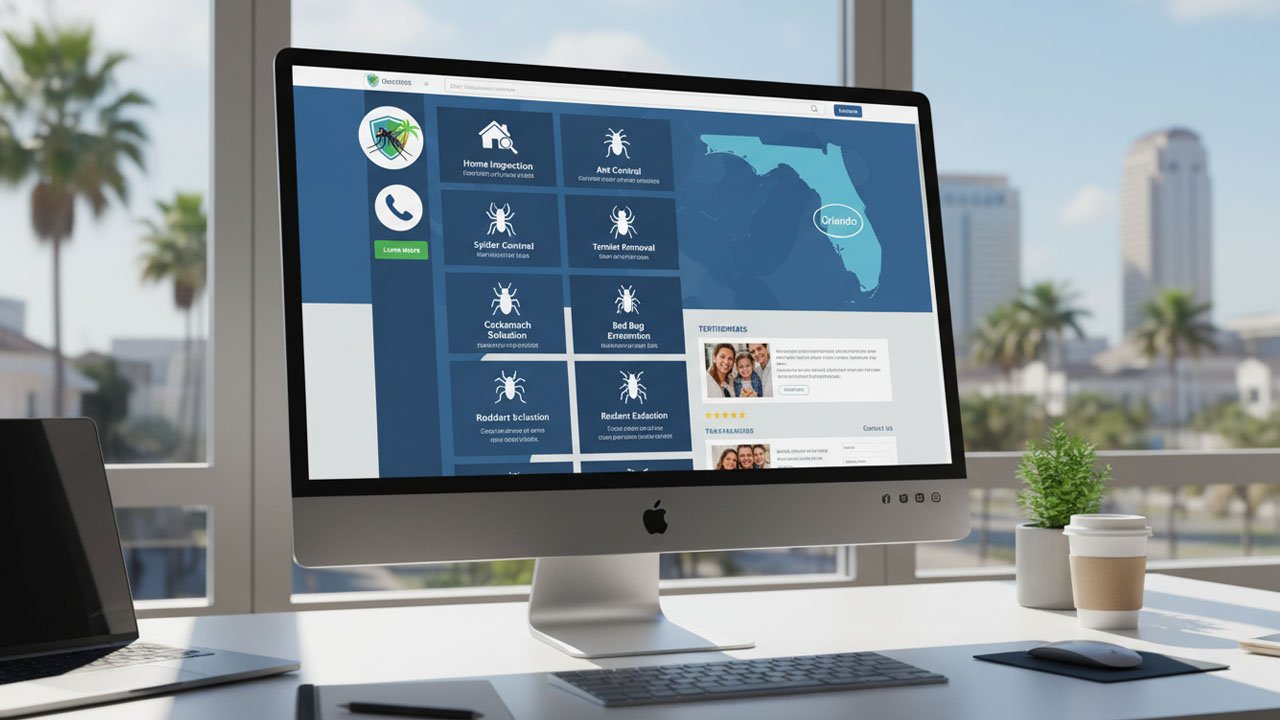
When someone in Orlando searches for pest control, they usually want one thing. They want the problem handled fast, and they want to talk to a real person. That is why we design pest control websites around calls first, not “pretty pages” first. A clean layout is not about showing off. It is about cutting hesitation, so a visitor turns into a booked job.
We have built and rebuilt enough home service websites to spot the same leak every time. The business is solid, the team is busy, the trucks are wrapped, but the website makes people work too hard to contact you. Fix that, and you usually feel it in the phone logs within days.
This is the layout we use when the goal is simple. More calls from Orlando homeowners, on mobile, with less friction.
The call-first rule we follow on every pest control site
The rule is blunt. A visitor should never have to hunt for your phone number. Google has said that 70 percent of mobile searchers report using click-to-call directly from search results to connect with a business. That stat is old, but it still matches how people behave today because the intent has not changed. When someone is stressed, they pick the fastest path.
So we built the website as if the call is the main product. On desktop, your phone number sits in the top right, big enough to notice without shouting. On mobile, your phone number becomes a tap target, not plain text. We also added a sticky call button that stays visible when someone scrolls, because scrolling is where most sites lose leads.
Right beside the call option, we place one more path. A short quote form. Some people will not call, even when they are desperate. Give them a second route that still feels quick.
Header and mobile elements that drive calls
| Element | What it does for conversions | Where it goes |
|---|---|---|
| Phone number as a button | Removes “copy and paste” friction | Header on mobile and desktop |
| Sticky call button | Keeps the next step visible while scrolling | Bottom area on mobile |
| One primary CTA button | Prevents decision overload | Hero section and repeated mid page |
| Short quote form link | Captures non callers | Header and CTA sections |
| Service area link | Helps visitors self qualify fast | Helps visitors self-qualify fast |
Homepage layout that turns “just looking” into a phone call
A strong pest control website homepage does not try to explain everything. It tries to get the visitor to take one of two actions. Call now, or request a quote. When we see a homepage with ten different buttons, a slider, and a giant wall of text, it almost always underperforms, even if the company is great.
Here is the homepage stack we like for Orlando
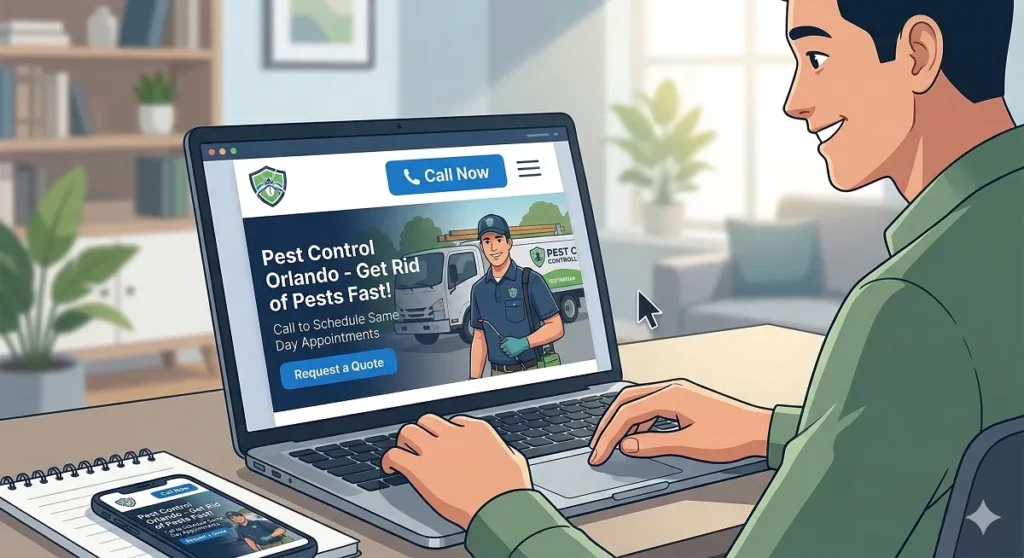
Start with a clear hero. The headline should name the outcome, not the company history. Something like “Pest control in Orlando with fast scheduling” beats “Welcome to our family-owned company.” Under the headline, add one short line that makes it feel real. Same week appointments. Licensed and insured. Family and pet-friendly options. Then add your two actions. Call now, and request a quote.
Immediately after the hero, show proof. Not a dozen badges. One tight proof block that people can scan. A review rating, one short testimonial, and a photo that looks local and human. A technician in uniform beats a stock photo of a generic house every time.
Then comes the services grid. Keep it short. Six core services are plenty. Orlando homeowners search for specific problems, so you want termite, roach, ant, rodent, mosquito, and a general prevention plan. Each service card should have one sentence that answers “Why should I click this?” and then a link to the service page.
After that, add a simple “how it works” strip. Three steps. Inspect, treat, follow up. Orlando customers want to know what happens after they click. It reduces fear, and it speeds up decisions.
Finally, repeat the CTA near the bottom. Same words. Same two choices. Do not change the offer just because someone scrolled.
Homepage sections and what each one is for
| Homepage section | Primary goal | Common mistake to avoid |
|---|---|---|
| Hero with two CTAs | Create instant action paths | Too many buttons and vague copy |
| Proof block | Build trust fast | Generic claims with no specifics |
| Services grid | Route people to the right page | Listing every service under the sun |
| How it works | Set expectations | Turning it into a long explanation |
| Service area teaser | Confirm you serve them | Hiding service area details |
| Final CTA | Catch the “scroll to decide” visitor | Using different CTA wording |
Mobile layout that stops silent lead leaks
If your pest control website only works on desktop, it is not working. A lot of pest control visits happen on a phone while someone is walking around the house, pointing the camera at a corner, or trying to keep a pet away from a mess. Mobile users are impatient for a good reason. They are in the middle of the problem.
We design mobile pages to feel light and fast. Portent published research showing that a site that loads in 1 second had an e-commerce conversion rate 2.5 times higher than a site that loads in 5 seconds. That is ecommerce, not pest control, but the behavior is the same. People drop when things feel slow, even if your service is amazing.
So we cut weight. We avoid big background videos on the homepage. We keep images compressed. We do not stuff the top of the page with oversized sections that push the CTA off-screen. The first scroll should reward the visitor with something useful, like proof, a service list, or a next step, not filler.
We also think about the thumb. A sticky call button near the bottom usually gets used more than a call link buried at the top. It is not a design trend. It is how people hold their phones.
Service pages that answer the real question fast
A pest control website’s service page should feel like a technician wrote it, not a committee. Orlando homeowners click into a service page because they want to confirm two things. Is this my problem, and can you fix it?
We start pest-type pages with symptoms. For roaches, that might be droppings, egg cases, or nighttime sightings. For termites, it might be mud tubes, discarded wings, or hollow-sounding wood. For rodents, it is usually noises, droppings, or damaged food packaging. This section should be short, but specific, and it should make the reader think, “Yep, that is exactly what I am seeing.”
Then we explain what causes it in plain English. Not a science lecture. A quick explanation that makes your treatment plan feel reasonable.
After that, we show the process. Inspection first. Targeted treatment next. Then prevention steps that keep it from coming right back. This is also where we answer the objections that stop calls. How long it takes, whether it is safe for kids and pets, and what the homeowner needs to do before you arrive.
We close service pages with the same two actions used on the homepage. Call now, or request a quote. Consistency matters because it trains people to move faster.
The quote flow that actually gets finished
A quote flow is a sales conversation starter. It is not a data collection project. The fastest way to kill leads is to ask for too much too soon.
We keep forms short because it works in the real world. Imaginary Landscape published a case study showing contact form conversions increased 120 percent after reducing fields from 11 to 4. That is the kind of difference that changes a month.
For pest control, we like a small set of fields that helps you respond quickly without scaring the visitor off. Name, phone, zip code, and pest issue are usually enough. If you want to add one more, add a preferred time window. That helps your office team call at the right moment.
Our recommended quote form fields for pest control
| Field | Required | Why it matters |
|---|---|---|
| Name | Yes | Makes the follow-up feel personal |
| Phone number | Yes | Calls close faster than email |
| Zip code | Yes | Confirms service area and routes correctly |
| Pest issue | Yes | Helps the tech prepare and sets urgency |
| Preferred time window | Optional | Improves answer rates on callbacks |
Do not forget the thank you message. A weak “we will contact you soon” makes people nervous, and nervous people fill out another form on another site. We set expectations instead. If the form arrives during business hours, you call within a defined window. If it is after hours, you call the next morning. That one detail reduces duplicate leads and makes you look organized.
Service area pages that fit how Orlando searches work
Orlando is not one single market. People search by neighborhood, suburb, and nearby city, depending on where they live and where they work. Your site should make it easy for a visitor to confirm you serve them without digging.
We like a service area hub page that is built for scanning. One short intro line that explains your radius and your core areas. Then, a clean list of the cities and neighborhoods you actually serve. Add a simple map if you have it, but do not let the map replace the list. People read lists faster than they interpret maps on small screens.
If you want to go further, build location pages for the areas that matter most to revenue. Do not crank out hundreds. Pick the places where you want to win, and where you already have customers. Then use the same structure every time. Local headline, top services, proof, and a clear CTA.
This is also where a trusted Orlando partner helps. If you want an example of what we build for this niche, our pest control web design service page breaks down how we approach layout, conversions, and local intent for Florida pest control companies.
Trust blocks that get the homeowner to pick you over the next company
Pest control is personal. You are entering someone’s home. The visitor needs to feel safe choosing you, and that trust has to happen fast.
We use trust blocks like decision triggers, not decorations. Near the top of the homepage, we show one proof point that is instantly believable, like a review rating or a short testimonial. On service pages, we add technician photos when possible, because people trust people. We also add a simple licensing and insurance statement, written in plain language, so it feels like a fact, not marketing.
Near the CTA, we include a guarantee if you have one, and we write it clearly. Vague promises feel like sales talk. Specific policies feel like a real business that stands behind its work.
We also avoid clutter. Too many badges and logos can backfire because it starts to look like the site is trying too hard. A few strong proof points win more than a wall of symbols.
Homeowners need to feel safe, and a professional pest control website builds that trust fast.
How do we build this in WordPress without making it complicated
WPFrank readers want practical steps, not theory, so here is how we translate this layout into a WordPress build.
We start with a fast, mobile-friendly theme and stick to clean templates. Then we build reusable sections in the block editor, so every page stays consistent: hero pattern, proof block, services grid, CTA strip. Once those pieces are right, building new service pages becomes quick and predictable, and the site feels cohesive.
For forms, we choose one reliable form plugin, keep the field count low, and set up notifications so the office responds quickly. We also test every page on a real phone over cellular. That is where most Orlando pest control leads live, and it is where small issues show up, like buttons that are too small or phone links that are not tappable.
If you want this layout to do its job, do one final test. Open your homepage on your phone and try to call your company with one tap. If it takes more than a second to figure out what to do, your layout is asking for too much, and the next pest control company in Orlando is getting your call instead.
At WPFrank, we specialize in building the perfect pest control website that turns visitors into booked jobs.